1 Person Killed After Massive House Blast in Chestertown
When I first read about what happened on Pentridge Lane, it struck me how fast a normal evening can turn into something no family is ever prepared for. A little before 6 p.m. on February 14, multiple 911 calls came in almost at the same time — people reporting a sudden explosion, then flames tearing through a two-story home just outside Chestertown. By the time the first units reached the property, the house wasn’t just burning… it was already collapsing in on itself.
If you’ve ever driven through that quiet stretch off Broadneck Road, you know it’s the kind of place where you expect calm, not chaos. That’s why this story hits harder. You and I both know that when a house explosion happens, it’s never “just an incident.” It shakes an entire community — not just the people who lived there.
And in this case, it took a life.
As we go deeper into what unfolded, how firefighters responded, and what investigators believe caused the blast, I want you to keep one thing in mind: events like this aren’t random. They leave clues, warnings, and lessons that matter for every homeowner.
Have you ever wondered how quickly a small hazard at home can grow into something this destructive?
What Happened in Chestertown?
When I went through the initial reports from WBOC, one thing was clear — this explosion didn’t give anyone a chance to react. It was around 5:50 p.m. when the first calls started pouring into 911. People in the area described a sudden blast, and seconds later, flames shooting through a home on Pentridge Lane.
By the time firefighters got there, the entire two-story house was already overwhelmed. You know how quickly fire spreads, but this wasn’t normal fire behavior. The damage told its own story — something inside had gone catastrophically wrong.
What hit me even harder was the location. That stretch off Broadneck Road is calm, rural, and usually quiet. The last place you’d expect to see a column of smoke rising into the winter sky. Yet that’s exactly what first responders saw as they pulled up: a house that wasn’t just burning… it was breaking apart.
How First Responders Mobilized?
As I read through the official update from the Chestertown Volunteer Fire Company Facebook page, I realized just how intense this response really was. Deputy Chief 6 saw the smoke while still driving in from Kennedyville — and before even reaching the home, he requested a Working Fire Dispatch, a Tanker Task Force, a fire boat, the State Fire Marshal, and the power company.
That tells you the scale right away. No hesitation. No “wait and see.” He knew this was bad.
But even with all that help coming, the crews arrived to find the same thing everyone else had seen: a home already destroyed from the inside. They set up hose lines, established water supply operations, and activated tanker shuttles because rural areas don’t always have reliable hydrants. It was a huge, coordinated effort — the kind you only see when everything has gone wrong at once.
And while all this was happening, one thing kept echoing in the background: a family member on scene telling firefighters that someone was still missing.
The Victim and the Survivors
The next morning, the Maryland State Fire Marshal confirmed the news everyone feared. The homeowner, Charles William Heaps, 68, didn’t make it out. His family had told responders the night before that he was unaccounted for, and tragically, their worry was right.
What struck me most was that five other family members escaped — his wife, children, and grandchildren. Imagine the chaos inside that house in those first moments. Imagine the shock of getting out, turning around, and seeing the place you call home consumed from the inside.
And to make the night even heavier, the family also lost a pet in the explosion. These are the details that never show up in the quick headlines, but they shape the emotional reality of what happened.
It reminded me of a heartbreaking case I covered recently in California, where a 14-year-old boy died in a sudden house fire.
What Investigators Believe Happened Inside the Home?
When I looked at the early findings from the Fire Marshal’s Office, one detail stood out immediately: investigators believe the victim was near a wood stove when the explosion happened. That alone isn’t unusual during a cold February evening. But what made this different was the presence of propane vapors and what officials called an “electrical event.”
If you’ve worked around heating equipment or propane before, you know how dangerous vapor buildup can be. It doesn’t take much. One spark, one switch, one moment — and everything changes.
Acting State Fire Marshal Jason M. Mowbray said something that stayed with me: conditions inside a home can shift fast when flammable gases are present. And he’s right. Most of us don’t think twice about the smells we notice or the appliances we use every day… until something reminds us how fragile that safety is.
The investigation is still ongoing, but these early clues paint a picture of a chain reaction that happened in seconds.
Why Firefighters Couldn’t Go Inside?
A lot of people wonder why firefighters don’t just run into burning homes — especially when someone is missing inside. I get that instinct. You probably feel the same way. But in this case, the decision was immediate: no one could safely enter the structure.
Here’s why.
When crews arrived, the house wasn’t just on fire — it was unstable. The walls, the roof, the floors… everything had been compromised by the explosion. Add in heavy flames and uncertainty about whether the water supply could keep up, and going inside would’ve meant sending firefighters into a structure that could collapse at any moment.
They had to fight this one from the outside. It’s not a choice any fire crew wants to make, especially when a family is standing there begging for help. But it’s the kind of judgment call that saves lives, even when it breaks your heart.
A similar situation unfolded in Northern Montgomery County, where firefighters couldn’t enter because of structural instability.
The Water Supply Battle: How 100,000+ Gallons Were Used
One thing that really stood out to me was how complicated the water situation became that night. If you’re not familiar with rural firefighting, it’s easy to assume a fire hydrant is always close by. But out on Pentridge Lane, that wasn’t the case.
Crews had to set up a fill site at Paper Mill Hill — basically turning the Cochran Glass parking lot into a temporary water station. In warmer months, firefighters would draft from the nearby creeks and rivers, but everything was frozen solid. I can imagine how frustrating that must’ve been for them in those first critical minutes.
So they relied entirely on Chestertown’s domestic water system. And because of the size of the fire and the distance, more than 100,000 gallons were pumped over the course of the night. That kind of draw doesn’t go unnoticed — parts of the town even saw temporary water discoloration.
And to make matters worse, a water main break happened on Flatland Road as the operation was winding down. Chestertown Water Utilities stayed out most of the morning making repairs. It’s one of those ripple effects that reminds you how a single emergency strains an entire community’s infrastructure.
While following incidents like this, I’ve seen how quickly new info can surface in real-time updates. If you like staying aware of emergency developments and safety alerts, I’ve found that following a reliable WhatsApp news channel helps you stay ahead without digging through dozens of reports.
The Scale of the Damage
When investigators called the home a total loss, it wasn’t an exaggeration. The explosion didn’t just spark a fire — it destroyed the structure from the inside out. The estimated damage sits at $2 million, which tells you the kind of force that ripped through that building.
I’ve read a lot of fire reports over the years, but what struck me here was that the value isn’t just financial. A family lost a home, memories, belongings, and someone they loved — all at once. Numbers are easy for people to gloss over, but behind every dollar is a lifetime of things that can’t be replaced.
This isn’t the kind of damage you bounce back from quickly. And I think you feel that too when you look at the scale of what’s gone.
I was reminded of another case out in West Valley City, where a family lost their home and their beloved cat in a devastating fire.
The Massive Multi-Agency Response
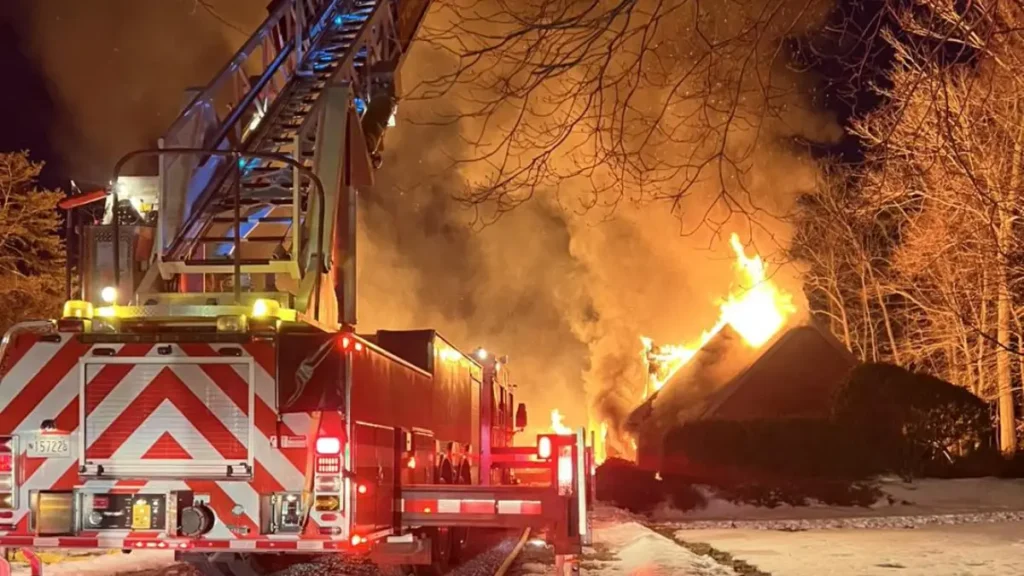
The number of agencies that showed up says a lot about how serious this incident was. You had crews from almost every corner of the county — Rock Hall, Kennedyville, Betterton, Millington, Galena, Sudlersville, Greensboro… and the list keeps going. More than a dozen fire companies joined in.
Add EMS, the sheriff’s office, the Maryland State Police, the Fire Marshal’s Office, Delmarva Power, and highway crews — and you start to understand the scale.
What I kept thinking while reading the reports was: rural communities rely on each other in ways you don’t always see until moments like this. One department alone can’t handle a catastrophe of this size. It takes everyone — tankers shuttling water, engines relaying hose lines, crews rotating in and out, investigators working overnight.
If you’ve ever lived in a small or rural town, you know how much these volunteer companies give up to keep their neighbors safe. Nights like this show it clearly.
Inside the Fireground: How Crews Actually Fought the Blaze
I want to break this part down because it shows just how technical and intense this response was.
Crews used a split lay with large-diameter hose — meaning Squad 6 stretched one supply line from the roadway to the scene, while Queen Anne’s Engine 55 pulled from another water source and connected the two systems together. This isn’t basic firefighting. It’s the kind of operation you use when the water you need is nowhere close to the fire you’re trying to reach.
Then they deployed a 2.5-inch attack line, which is meant for heavy fire — the kind you simply can’t put out with a standard handline. Water supply had its own radio channel because coordinating dozens of tankers without clogging fireground communications is a job on its own.
When I read through the Facebook briefing, one thing became obvious: despite the chaos, the teams operated with precision. And you know what? Most people never hear these details. But these are the moments that show how firefighters think on their feet, solve problems, and work under pressure most of us can’t imagine.
How the Investigation Could Shift in the Coming Days?
When I look at cases like this, the first 72 hours usually set the direction for everything that follows. If state fire marshals find even one unusual burn pattern, chemical trace, or structural weakness, the entire narrative can change quickly.
Right now, officials are focusing on the debris field, the blast pressure direction, and appliance remnants. If any of those raise questions, we’ll likely see new agencies step in — especially if something points toward criminal behavior or a widespread safety issue.
You might see updates slow down for a bit, not because nothing is happening, but because investigators hate releasing half-baked findings. They want accuracy over speed, and honestly, that’s what matters in situations like this.
The Emotional Aftermath No One Talks About
You and I both know explosions aren’t like other emergencies. They leave behind a heaviness — a mix of shock, fear, and unanswered questions.
Even people who weren’t physically close to the scene feel it. You hear a loud boom once, and suddenly every rumble or siren hits differently. I’ve seen neighborhoods struggle with sleep, kids refusing to stay home alone, and families staring at their gas meters like they’re ticking bombs.
What makes it harder is that explosions are rare, so people never feel fully prepared. That’s why clarity matters here — not just for safety, but for closure. When the cause becomes known, the community finally gets space to breathe again.
Why This Story Stays With You?
Some incidents fade fast. This one doesn’t — and I think you feel that too.
A home isn’t supposed to vanish in seconds. A life isn’t supposed to disappear in the time it takes to hear a blast. When something so sudden happens in a quiet place like Chestertown, it challenges what we assume about our own safety.
As I wrote through each part of this story, I kept thinking about how many people will replay that moment in their minds, even if they only heard it from a distance. That’s the kind of event that becomes part of a town’s memory.
Final Thoughts
If there’s one thing I take from this, it’s how fragile those ordinary moments are — the quiet morning, the familiar house, the routine day. And when something like this happens, it pushes all of us to think a little deeper about how we protect our homes and the people inside them.
I’ll keep following the investigation and updating the story as officials release more. For now, I’d genuinely like to hear your take:
Do you think explosions like this change how safe people feel in their own homes?
Your perspective matters — and it helps shape the way we talk about events like this moving forward.
By the way, if you want quick updates whenever incidents like this develop, you can follow us on X and join the Facebook community — both places where I share real-time alerts and context that doesn’t always make it into the longer articles.
Disclaimer: This article is based on information available at the time of writing and may be updated as officials release new details. Nothing here should be taken as a final cause determination. Always refer to official statements for the most accurate and confirmed information.