A Rock From Space Fell Through This Man’s Ceiling and He Did the One Thing That Changed Everything
On the afternoon of July 16, 2024, a man in Hillsborough, New Jersey heard a loud crash from his bedroom. He walked in to find a hole in his ceiling, black dust covering his bed, and a sharp sulfur smell in the air.
What he did next became the reason scientists could do their jobs at all.
Two years later, that rock is the subject of a study in the journal Science Advances. And NASA is calling this one of the most significant meteorite recoveries in recent history.
The Day a 4-Billion-Year-Old Rock Chose Hillsborough
It started as a fireball.
A space rock roughly the size of a heavy airline bag entered Earth’s atmosphere at 32,000 miles per hour. People across New York, New Jersey, Connecticut, Rhode Island, and Pennsylvania watched it streak across the daytime sky.
As it passed just south of the Statue of Liberty, it triggered a sonic boom loud enough to shake buildings in New York City.
The rock broke apart 22 miles above Earth. Newark Airport’s Doppler radar tracked a cloud of fragments falling from Staten Island into New Jersey.
One fragment made it all the way down, punched through a roof, and landed in a Hillsborough bedroom.
What He Did in the Next 30 Minutes That Mattered Most
The homeowner, who chose to remain anonymous, described what he found. A hole in the ceiling. A sulfur-like odor. Black fragments and dust covering everything around him.
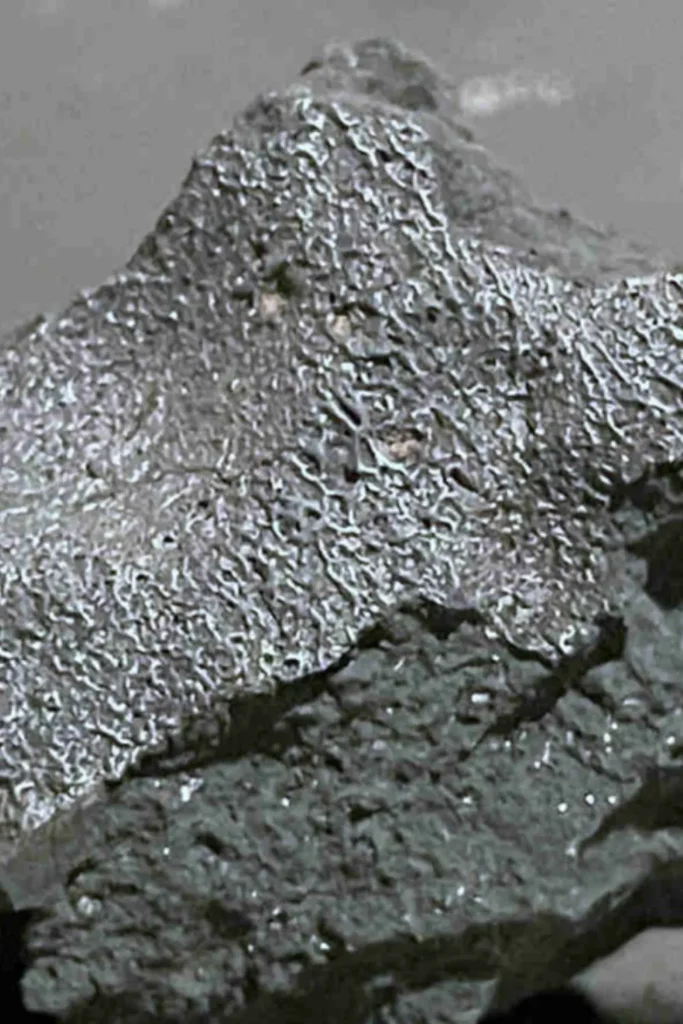
He did not touch anything with his bare hands.
He pulled on disposable gloves, wrapped the fragments in aluminum foil, and placed them into clean glass jars.
He then called the American Meteor Society almost immediately, reaching study co-author Mike Hankey, who guided him through preserving the sample. Before rain fell that evening, he also patched the roof.
That last step mattered more than it sounds. The rock is porous and absorbs moisture from the air. Rain would have contaminated or dissolved the fragile minerals inside entirely.
Peter Jenniskens, lead author of the study at the SETI Institute and NASA’s Ames Research Center, said it plainly: “Thanks to the homeowner’s quick reaction, these are the most pristine CM1/2 meteorites we know of.”
The homeowner later shared: “We knew almost immediately that what happened to us was incredibly rare and we felt a responsibility to preserve the meteorite for the scientific community.”
What the Rock Actually Is, and Why It Barely Exists on Earth
The rock was classified as a CM1/2 carbonaceous chondrite, a rare intermediate category sitting between two standard meteorite types. This was only the second CM1/2 ever recovered from an observed fall on Earth.
Inside it, scientists found organic compounds, amino acids, and salty mineral fragments.
Dr. Danny Glavin, senior scientist at NASA’s Goddard Space Flight Center, noted: “Most of the amino acids detected in Hillsborough are rare or nonexistent in life on Earth, so they are truly extraterrestrial in origin.”
The salty fragments pointed to where the rock originated on its parent asteroid: near the surface, where liquid water had once evaporated and left concentrated salt deposits behind.
Moments like this, where something unexpected crashes into a home and reshapes everything that follows, carry real weight. A family in Boise found themselves with nowhere to go after a car struck their home, a reminder of how fast a single impact changes everything inside four walls.
If you follow stories where science meets real life, there is a WhatsApp channel that covers moments like this as they develop. Worth keeping on your radar.
Why This Matters
This is not just a rock-through-a-ceiling story.
The Hillsborough meteorite is roughly 4 billion years old. Researchers are now comparing its salt minerals to samples from asteroid Bennu (NASA OSIRIS-REx, 2020) and Ryugu (Japan’s Hayabusa2, 2019), both linked to ancient water activity.
The study, published in Science Advances in July 2026 exactly two years after the crash, was led by scientists from NASA, the SETI Institute, and research teams across the US, UK, and Japan.
Danny Glavin put it directly: “It is just more proof that the chemical building blocks of life could have been delivered, and are still being delivered, to Earth today by these carbonaceous asteroid fragments.”
A driver in Visalia caused significant structural damage to a home after a medical emergency, and recovery took weeks. Unexpected impact rarely gives you time to prepare. In Hillsborough, the homeowner had no time either. He just used what little he had better than most people would.
A house in Lebanon was struck while nobody was even home, leaving damage with no witness and no immediate response. The Hillsborough story is the opposite of that. Someone was there, paid attention, and that made all the difference.
Key Takeaways
- The meteorite crashed through a Hillsborough, NJ bedroom on July 16, 2024, spotted the same day across five states
- The homeowner preserved fragments using gloves, aluminum foil, and glass jars within minutes
- He patched the roof before rain arrived that evening, preventing contamination of the porous rock
- Scientists classified it as CM1/2, only the 2nd of its kind ever recovered from an observed fall
- It contains extraterrestrial amino acids not found in Earth-based life
- Salt minerals inside are being compared to samples from asteroids Bennu and Ryugu
- Fragments are now on display at the American Museum of Natural History in New York City
If you were home when that crash happened, what would your first move have been? Would you have thought to grab gloves, or would the shock have taken over? Drop your answer in the comments.
Wrapping Up
A rock that spent 4 billion years crossing the solar system ended its journey in a New Jersey bedroom. And the person who found it responded with enough presence of mind to preserve something scientists may study for decades.
If this kind of story is your thing, Build Like New covers real-world moments where homes, science, and human decisions collide in ways nobody saw coming. Worth bookmarking.
For stories like this as they break, follow Build Like New on X (Twitter) and join the conversation over on the Facebook community. That is where these moments get discussed in real time.
Disclaimer: This article is for informational purposes only. All details are based on publicly available reports and the study published in Science Advances in July 2026.