
7 Reasons You Should Stop Buying Cleaning Bottles (And What to Use Instead)
Look under most kitchen sinks. You’ll find a graveyard of half-empty plastic bottles, mismatched labels, and cleaners you bought once and forgot about.
The average household goes through around 12 cleaning bottles a year, and almost none of them get recycled properly.
Smart homeowners are waking up to something the cleaning industry doesn’t want you to think too hard about: you’re not buying cleaner. You’re buying plastic, water, and packaging every single time.
Here’s why the switch to refillable cleaning bottles isn’t just a feel-good trend. It’s genuinely the smarter move.
1. You’re Paying for Water (Literally)
Most conventional cleaning sprays are up to 90% water. The remaining 10% is the actual cleaning formula: surfactants, preservatives, and fragrance.
You’re paying to fill a plastic bottle with tap water, ship it hundreds of miles, and then throw the whole thing away when it’s empty. That’s the business model.
Refillable concentrates flip this. You add your own water at home. You’re only buying the formula, the part that actually cleans.
2. The Recycling Myth Needs to Stop
Most people rinse out their cleaning bottles and feel good about tossing them in the blue bin. Here’s the uncomfortable truth: that bottle is almost certainly going to a landfill anyway.
Plastic recycling rates in the US have dropped in recent years, from 9% in 2018 down to around 5% today. The “recyclable” symbol on your bottle is a material label, not a promise.
An estimated 2.5 billion plastic cleaning bottles hit landfills every year in the US alone. Refillable systems eliminate this problem at the source, not at the recycling facility.
3. Your Home’s Air Quality Is Taking a Hit
This is the reason most cleaning articles skip entirely, and it matters more than plastic waste for families with kids or pets.
Conventional cleaning products contain Volatile Organic Compounds (VOCs), chemicals that vaporize at room temperature and linger in your indoor air.
According to the American Lung Association, VOC concentrations indoors can be up to 10 times higher than outdoors. Long-term exposure is linked to respiratory issues, headaches, and in some cases, liver and kidney damage.
A 2023 EWG study found that conventional cleaning products emit an average of 22 hazardous VOCs per use. Green, fragrance-free alternatives? About 3.
Refillable cleaning brands tend to skip synthetic fragrances and harsh solvents entirely. That’s not a marketing claim. It’s a formulation choice that directly affects what you’re breathing at home.
If you want to go deeper on this, we’ve already covered the specific cleaning product you should never touch and what to actually use instead. Worth a read before you restock.
4. The Real Cost Math (It Adds Up Fast)

A family of four spends an average of $680 a year on cleaning products. The upfront cost of a refillable system, a glass or aluminum bottle plus a starter pack of concentrates, is typically recovered within two to three refill cycles.
After that, you’re only buying the concentrate. Most households save $100 to $200 per year once they’ve switched their full cleaning routine. Over five years, that’s real money.
The hidden cost people miss? Paying for water and plastic packaging every single time. Refillable concentrates cut both.
A lot of homeowners who made this switch shared that the savings surprised them most. There’s a community discussing exactly these kinds of practical home decisions.
This WhatsApp channel has been sharing some genuinely useful tips lately if you’re interested.
5. Greenwashing Is Real and Single-Use “Eco” Bottles Are Part of It
Walk down the cleaning aisle and you’ll see green leaves, “earth-friendly” labels, and blue water imagery on single-use plastic bottles. That’s not sustainability. That’s branding.
A product is only genuinely sustainable if the system is refillable, not just the formula inside. As The Spruce notes in their coverage of refillable cleaning products, the real shift comes from keeping the same bottle and only replacing the concentrated refill.
Look for third-party certifications like EWG Verified, Leaping Bunny, or Cradle-to-Cradle rather than brand-designed eco badges. Those mean something. A green leaf doesn’t.
6. Your Under-Sink Cabinet Is Cluttering Your Head, Too
This sounds small, but it isn’t. A cabinet full of mismatched, half-empty bottles from seven different brands creates low-level mental noise every time you open it.
Switching to one unified refillable system, same bottle shape, same labels, always stocked, removes a micro-decision you didn’t even know you were making.
While you’re rethinking what’s under the sink, it’s also worth reconsidering what’s doing the cleaning. Hydrogen peroxide is one of the most underrated kitchen cleaners out there and it pairs well with a minimal, refillable setup.
Cleaner cabinet, less friction, one fewer thing to think about when you just want to wipe down the counter.
7. It’s a Simpler Routine, Not a More Complicated One
People assume “eco cleaning” means DIY vinegar recipes, complicated mixing ratios, and products that don’t actually work. That’s not what refillable systems are.
You buy the bottle once. You drop in a tablet or pour in a concentrate. You add water. You’re done.
The cleaning performance of most refillable brands now matches or beats conventional products. Many have third-party efficacy testing to back that up. The learning curve is essentially nonexistent.
What to Use Instead
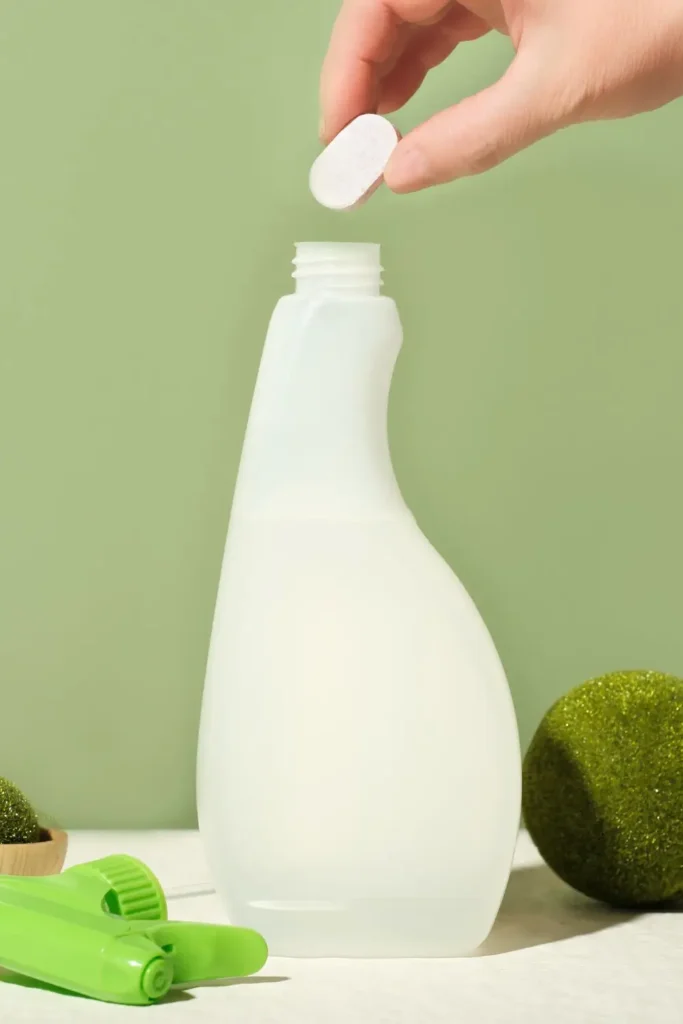
If you’re ready to make the switch, you don’t need to overhaul everything overnight. Start here.
- Dissolvable tablet cleaners like Blueland or Meliora are the easiest entry point. You get a reusable bottle, drop in a tablet, fill with water, and you have a full bottle of all-purpose cleaner in under a minute.
- Concentrate pouches from brands like Grove Collaborative or Branch Basics let you dilute at home. One small pouch replaces multiple full-sized bottles. Great if you clean a lot and want to buy in bulk.
- Aluminum or glass spray bottles are worth investing in once. They don’t absorb odors, don’t leach chemicals, and last for years. Way better than cheap plastic bottles that start smelling weird after a few refills.
- For laundry, laundry sheets or powder concentrates are the cleanest swap. No plastic jug, no measuring cup, just tear a sheet or scoop the powder. Brands like Earth Breeze and Tru Earth have been around long enough to have solid track records.
The rule of thumb: start with whichever product you run out of most often. Swap that first, get comfortable, then expand from there.
Why This Matters
Here’s the scale of what’s sitting behind your cleaning cabinet choices: over 400 million tonnes of plastic are produced globally every year, with roughly 31.9% of it mismanaged, entering soil, waterways, and air.
Cleaning product packaging is a solvable, specific slice of that problem.
One household switching to a full refillable routine keeps around 60 plastic bottles out of landfills over five years, per product. Multiply that across a neighborhood, a city, and the math becomes impossible to ignore.
The switch doesn’t require sacrifice. It requires one decision, one starter kit, and one habit swap.
Key Takeaways
Start with the product you go through fastest, usually all-purpose cleaner or dish soap. Buy the reusable bottle once.
Choose a concentrate or dissolving tablet format, not just a “refillable” pouch that’s still single-use packaging in disguise. Read the formula, not just the packaging.
And if you’re building a cleaning routine that actually holds up month to month, this guide on 6 things most people forget to clean monthly is a solid next step, especially once you’ve got the right products in place.
Give yourself two to three months before judging. The habit builds naturally.
Already made the switch, or still on the fence? Drop a comment below, whether it’s what convinced you, what brand you’re using, or a question you still have. These real-world experiences are way more useful than any product listing.
Conclusion
The shift to refillable cleaning bottles isn’t about being perfect. It’s about being practical: spending less, breathing cleaner air, and making one small decision that actually holds up when you think it through.
For more practical home guides like this one, visit Build Like New and if you want these tips in your feed, come find us where we actually post:
Follow on X (Twitter) for quick home tips and updates, and join the conversation on Facebook where we share longer guides, before/afters, and reader questions.
Disclaimer: This article is for informational purposes only. Product savings and health outcomes may vary based on household size, usage, and brand. Always check product labels for ingredients, especially if you have allergies or sensitivities.


