
12 Things Filling Your Closet That Belong Somewhere Else
Open your closet right now.
Before you even touch anything, notice how it makes you feel.
If it feels stuffed, chaotic, or slightly overwhelming, you’re not imagining it. A packed closet doesn’t just take up physical space — it quietly shrinks the way your entire home feels.
I’ve seen this over and over. People think they need a bigger bedroom, a bigger house, more storage. But the real issue isn’t space. It’s what we’re holding onto.
A proper closet clean out isn’t about folding better or buying matching hangers. It’s about removing the things that don’t belong there anymore — the clothes you haven’t worn in years, the “someday” outfits, the duplicates you forgot you owned.
When you clear those out, something shifts. The air feels lighter. Getting dressed takes minutes instead of frustration. And somehow, the whole room feels bigger — even though the walls haven’t moved an inch.
If your closet feels tight, crowded, or stressful, you’re about to find out exactly what needs to go.
Let me ask you something — how much of what’s in your closet do you actually wear right now?
What “Closet Clean Out” Really Means
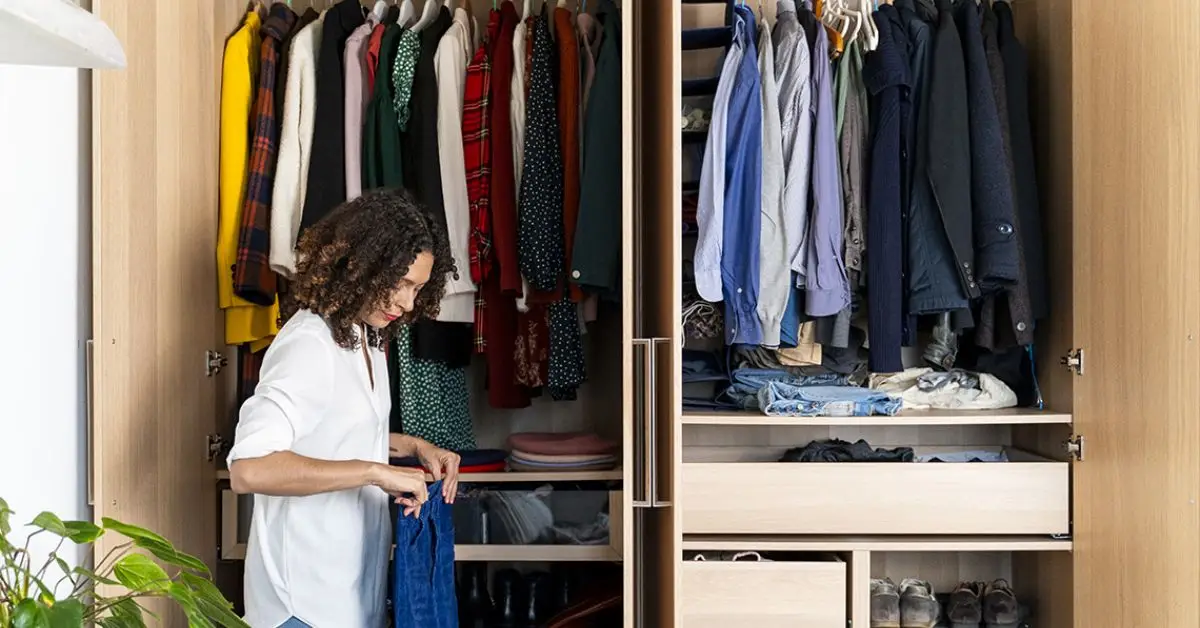
When I say closet clean out, I don’t mean shifting hangers around.
I don’t mean folding better.
I don’t mean buying storage boxes.
I mean removing what no longer deserves space in your home.
Most people confuse cleaning out with organizing. But they’re not the same. And if you skip this distinction, you’ll end up rearranging clutter instead of actually creating space.
Let’s clear that up.
Closet Clean Out vs. Closet Organization
Here’s how I explain it to you in the simplest way:
Closet clean out = removing.
Closet organization = arranging.
If you organize before you remove, you’re just giving unnecessary items a prettier place to live.
When you properly clean out, you:
- Let go of clothes you haven’t worn in 12+ months
- Remove duplicates you keep “just in case”
- Stop storing clothes that don’t fit your current life
- Clear out pieces you don’t even like wearing
Only after this step does organization make sense.
And once you’re ready to organize what’s left, these small closet organization steps will help you keep things simple and practical.
Think about it — you wouldn’t reorganize a fridge full of expired food. You’d throw things away first.
Your closet deserves the same logic.
The Psychological & Spatial Impact of Cleaning Out Your Closet
Now here’s something most people don’t think about.
An overloaded closet doesn’t just shrink your storage — it shrinks how your entire room feels.
When I walk into a space with an overstuffed closet, I can feel the visual pressure. Too many colors. Too many options. Too much noise.
And there’s a bigger picture too.
According to the U.S. Environmental Protection Agency textile waste report millions of tons of textile waste are generated every year — much of it from clothing that sits unused before being discarded.
That tells you something important: we own far more clothing than we actually use.
When you finally remove the excess, you’ll notice:
- Your room feels more open
- Your mornings become easier
- You stop feeling overwhelmed when you open the door
- Your space looks bigger without changing a single wall
I’ve seen bedrooms feel instantly lighter after a serious closet clean out — no renovations, no new furniture, just less stuff.
So before you think about buying organizers, ask yourself:
Are you organizing your closet… or are you ready to truly clear it?
The 12 Closet Items You Should Get Rid Of
This is where it stops being abstract and starts making real space in your room.
As you read, picture your closet. Be honest — if an item fits the rule, it doesn’t stay just because you might wear it someday.
1. Clothes You Haven’t Worn in 12+ Months
- Why this weighs down your space: If you didn’t reach for it over all seasons, it usually isn’t part of your real wardrobe — it’s just taking up space.
- Quick rule for letting it go: If it hasn’t been worn in a year, it doesn’t stay.
- Tip for what to do instead: Donate it so someone else can actually use it. A good place to start is Goodwill’s donation info page.
2. Outdated Fashion You’ll Never Revisit
- Why this weighs down your space: Old trends don’t just occupy physical space — they hold mental space too. Seeing them reminds you of past versions of yourself instead of who you are now.
- Quick rule: If you wouldn’t buy it today, let it go.
- Tip for what to do instead: Keep one nostalgic item if it’s meaningful — but no more.
3. Duplicates (More Than Two of the Same Item)
- Why this weighs down your space: Three black tees don’t give you variety — they give you clutter.
- Quick rule: Keep your top two favorites. Release the rest.
- Tip: Consider donating one or two of the extras to keep your options fresh without crowding.
4. Items That Don’t Fit Well
- Why this weighs down your space: Clothes that don’t fit are invisible when you’re choosing outfits — yet they take up real space.
- Quick rule: If it doesn’t fit right now, it doesn’t stay.
- Tip: Take a photo and let those visual reminders help you release what doesn’t serve you.
5. Broken, Missing Buttons, Stained Items
- Why this weighs down your space: These aren’t wearable — they’re placeholders for procrastination.
- Quick rule: If it hasn’t been fixed in 30 days, it goes.
- Tip: Create a small repair pile with a deadline — if you miss it, donate or recycle.
6. Shoes That Cause Pain or Aren’t Worn
- Why this weighs down your space: Shoes take up disproportionate floor space, and painful ones sit untouched.
- Quick rule: If you wouldn’t walk in them comfortably, let them go.
- Tip: Donate gently used shoes so they can be worn again by someone who needs them.
7. Unfinished DIY or Alteration Clothes
- Why this weighs down your space: These are procrastination items dressed up as potential.
- Quick rule: If it’s been waiting more than 3 months, it’s not getting done.
- Tip: Only keep projects you’ve set actual time aside to finish.
8. Old Accessories Without Purpose
- Why this weighs down your space: Scarves, belts, bags — these accumulate quietly and clutter your closet edges.
- Quick rule: If you haven’t used it this past year, it doesn’t stay.
- Tip: Donate accessories that are still in good condition.
9. Seasonal Clothes Without a Storage Plan

- Why this weighs down your space: Mixing in-season and off-season clothes visually compresses your closet.
- Quick rule: If it’s not in season, store it elsewhere.
- Tip: Rotate twice a year with clear, labeled bins.
10. Sentimental Clothes You Think You’ll Wear but Won’t
- Why this weighs down your space: Sentimental pieces create emotional obstacles — you keep them just in case.
- Quick rule: Limit sentimental items to one small box.
- Tip: Take photos before letting go to preserve the memory without the clutter.
11. Empty Hangers / Miscellaneous Non-Clothing Items
- Why this weighs down your space: Empty hangers and random odds and ends create visual chaos.
- Quick rule: If it’s not wearable clothing, it doesn’t belong here.
- Tip: Remove these to create cleaner sight lines.
12. Items That Are “Fine” but Bring You No Joy or Function
- Why this weighs down your space: Clothes you’re indifferent about still take up valuable space.
- Quick rule: If it doesn’t serve you or make you feel good, it doesn’t stay.
- Tip: Donate these pieces so someone who will wear them gets value from them.
As you go through this list, pay attention to your instincts. What do you already know needs to go — even before you finish reading?
Clean out with intention, not hesitation.
How to Decide Quickly During a Clean Out
Most people don’t struggle with what to remove.
They struggle with deciding.
You pick up a shirt… and suddenly you’re debating memories, price tags, future versions of yourself. That’s how a 30-minute clean out turns into a 3-hour emotional workout.
So let’s simplify the process.
Use the 3-Second Rule for Quick Decisions
When you hold an item, give yourself three seconds.
That’s it.
Your first instinct is usually the honest one. If you struggle with quick decisions, you can also try the 90/90 decluttering rule — it’s another simple way to cut through emotional hesitation fast. The longer you stare at something, the more excuses you create.
Here’s how I use this rule:
- Pick up the item
- Ask: “Would I wear this this month?”
- If the answer isn’t an immediate yes, it goes in the remove pile
Why this works: It cuts emotional overthinking. You move faster, and momentum keeps you going.
Clean outs fail when you pause too long.
The “Fit + Joy + Use” Matrix
If you want something more structured, use this simple framework. I teach this because it’s practical and easy to remember.
For every item, ask:
Fit — Does it fit my body right now?
Joy — Do I actually like wearing it?
Use — Have I worn it recently in real life?
If it doesn’t pass at least two of these three, it doesn’t stay.
This removes guilt from the equation. You’re not throwing away value — you’re choosing function.
And once you start applying this consistently, decision-making becomes faster. You stop negotiating with every hanger.
Expert Tip That Sticks
Professional organizers often say something simple that I’ve found incredibly true:
“Clutter is delayed decisions.”
That line hits because it’s accurate. Every unworn item is a decision you postponed.
When you approach your closet like that, you stop asking, “Should I keep this?”
You start asking, “Why am I avoiding deciding on this?”
And that shift changes everything.
What to Do With the Items You Remove
This is where most articles stop.
They tell you what to declutter — but not what to do next. And when you don’t have a plan, the donation pile just sits in a corner for weeks.
Let’s avoid that.
Donate vs. Sell vs. Recycle — How to Choose

Not everything should be sold. Not everything should be donated.
Here’s how I decide:
- Donate: Everyday clothing in good condition
- Sell: Higher-value brands, barely worn pieces
- Recycle: Damaged textiles that can’t be worn
The key is speed. The longer items sit in bags, the more likely they’ll creep back into your closet.
Best Donation Options
If your clothes are in wearable condition, donation is the fastest and cleanest exit strategy.
You can start with The Salvation Army’s donation locator.
They make it easy to find local drop-offs, which helps you move items out quickly instead of letting them sit around.
Quick Resell Tips (Apps & Etiquette)
If you choose to sell, be realistic.
- Price fairly — not emotionally
- Take clear photos in good lighting
- Don’t over-list items that barely have demand
If something doesn’t sell within 30 days, reconsider donating it. Your goal is space — not storage in a different form.
Textile Recycling Near You
Some items shouldn’t be donated — especially torn, heavily stained, or worn-out fabrics.
Look for:
- Local textile recycling bins
- Municipal recycling programs
- Retailer take-back initiatives
A quick search with your city name + “textile recycling” usually gives you options nearby.
The faster you move items out of your home, the faster you feel the difference.
So let me ask you — once you bag everything up, how quickly can you get it out of your house?
How a Closet Clean Out Makes Your Home Feel Bigger
This is the part most people underestimate.
You think you’re just clearing hangers.
But what you’re really doing is changing how your entire room feels.
Let me show you how.
Visual Space Expansion and Perception
When your closet is overstuffed, your eyes register density.
Too many colors.
Too many shapes.
Too much visual interruption.
Even if the door is closed, that packed space affects how the room feels. The moment you reduce what’s inside, you create visual breathing room.
Less density = more perceived space.
I’ve watched people step back after a clean out and say, “It feels like I have a bigger room.” The walls didn’t move. The volume of stuff did.
Faster Outfit Selection = Less Daily Stress
Here’s something practical.
When your closet only holds what fits, what you love, and what you actually wear, getting dressed becomes simple.
No more:
- Trying on five outfits
- Staring at “nothing to wear”
- Feeling overwhelmed before your day even starts
You make decisions faster. And when you start your morning with clarity instead of frustration, that calm carries into the rest of your home.
A lighter closet often leads to a lighter routine.
Better Airflow + Zero Visual Noise
Closets that are packed tight trap more than clothes — they trap dust, stale air, and cluttered energy.
When you create space between items:
- Air moves better
- Shelves look cleaner
- The room feels fresher
And visually? There’s no noise.
You open the door and see space instead of chaos. That calm visual gap changes how your brain processes the room.
Space isn’t just physical. It’s psychological.
Real-Life Before & After Effect
Spend five minutes on any decluttering thread online and you’ll see the same pattern.
Before:
Closet crammed. Overwhelmed owner. “I feel suffocated.”
After:
Half the items gone. Clear floor. Matching hangers.
And the most common comment?
“It feels like I renovated.”
That’s the power of removal.
You don’t need more square footage.
You need fewer obstacles.
Common Mistakes to Avoid

Even smart people sabotage their own clean outs. I see these patterns all the time.
Avoid these, and your results will stick.
Saving Items “Just in Case” Without a Plan
“Just in case” is the most expensive phrase in a closet.
If you keep something for a hypothetical event with no date attached, it becomes permanent clutter.
If you truly need a backup, define the scenario clearly. Otherwise, let it go.
Not Categorizing Before Cleaning
If you randomly grab items, you won’t see patterns.
Pull everything out by category:
- All jeans together
- All shoes together
- All jackets together
When you see five similar items at once, decisions get easier.
Clutter hides in isolation. It’s exposed in categories. If you often feel stuck while decluttering, learning how to reverse declutter can completely shift the way you approach your space.
Ignoring Footwear and Accessories
People declutter clothes… and forget the bottom shelf.
Shoes, belts, scarves, bags — these silently crowd your space.
If you skip them, your closet will still feel tight.
Every category counts.
Final Thoughts
At the end of the day, a closet clean out isn’t about minimalism. It’s about alignment.
Your closet should reflect who you are now — not who you were, not who you might become, and not who you feel guilty about not being.
When you remove what doesn’t belong, your home feels bigger because your life feels lighter.
Now I want to hear from you.
What’s the first item in your closet that you already know needs to go? Drop it in the comments.
And if you found this helpful, you’ll love what we share at Build Like New — where we talk about practical ways to improve your home without unnecessary spending.
Go check it out, and start building your space the way it should actually feel.
Disclaimer: This guide is for informational purposes only and is based on practical home organization experience. Results may vary depending on your space, lifestyle, and personal needs. Always use your judgment when donating, selling, or recycling items, and check local guidelines before disposal.


