The Man Who Built Mansions for Groucho Marx and Judy Garland Also Built This Bubble Home Now Selling for $1.95M
The man who designed mansions for Groucho Marx, Judy Garland, and Douglas Fairbanks Jr. chose to spend his final years in a 1,000 sq ft concrete dome.
That choice was not irony. It was a statement.
Wallace Neff believed this house was his most important work. Now it is the only one left in America, and it just hit the market for $1.95 million.
The House He Built for His Brother
Neff designed the Airform house in 1946 at 1097 S. Los Robles Ave. in Pasadena, originally for his brother Andrew. The idea had come to him years earlier while shaving, when he watched a soap bubble hold against his finger. “Build with air,” he thought.
The construction method was unlike anything before it. A rubberized balloon was inflated over a concrete slab, covered in chicken wire, and sprayed twice with gunite.
No wood. No nails. The whole structure was up in roughly 48 hours. The balloon was deflated and pulled out the front door, leaving behind a reinforced concrete dome.
Neff himself moved in later and lived there until his death in 1982.
The Listing, The Story, and the Bomb Shelter
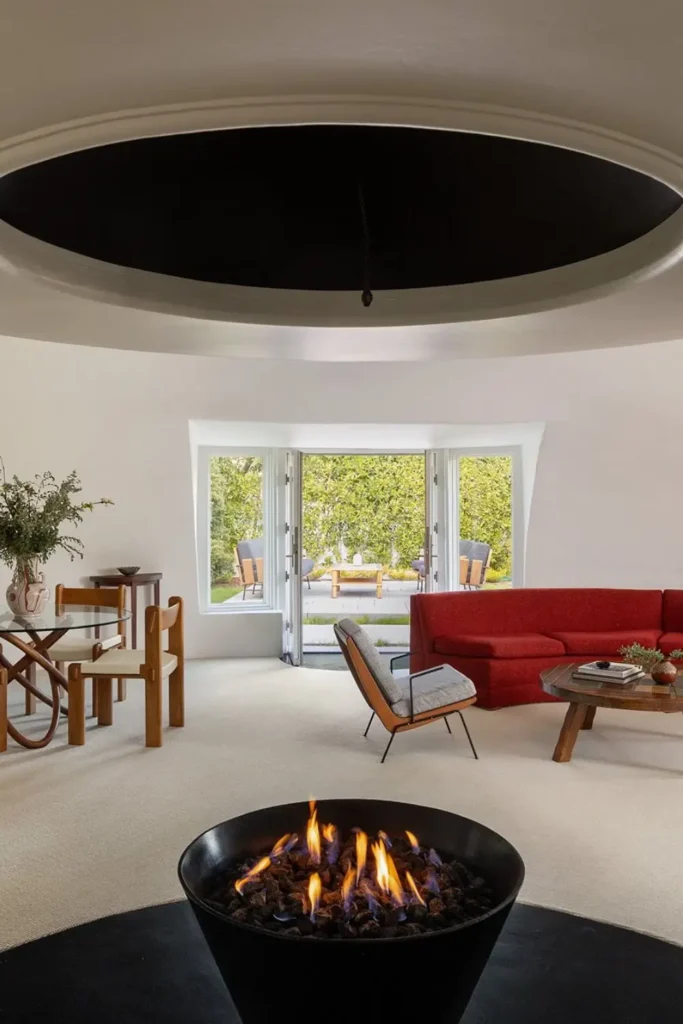
The property sits on an approximately 9,000 sq ft corner lot: 2 bedrooms, 1 bath, 1,204 sq ft of living space priced at $1,620 per sq ft. Inside, a semicircular living room wraps around a central fireplace, flowing into the kitchen and bath.
The thick curved walls naturally keep the interior cool through Pasadena summers.
The last owners were abstract artist Steve Roden and his wife Sari, who bought it in 1998 for $260,000 and called it the “Shell House.” Steve passed away in September 2023 from Alzheimer’s complications at just 59.
His widow is now selling, represented by Crosby Doe Associates, the same firm that sold them the house in the first place.
The property also includes a 1,000+ sq ft detached studio with ADU plans pending with the city, and an underground bomb shelter built in the 1960s during the “Duck and Cover” era using the same Airform method, sitting roughly 15 feet below ground.
It was designed to shelter a family of four to five per Office of Civil Defense standards. The listing agent says it could make an excellent wine cellar.
Why the Idea Never Caught On Here
Of the 400,000 Airform homes Neff planned to build across America, fewer than 3,000 were ever constructed. Americans rejected the shape. Critics called the curved walls impractical. The government looked away.
Overseas was a different story. Airform houses went up in Senegal, Cairo, and Rio de Janeiro. In Dakar alone, roughly 1,200 were built between 1948 and 1953.
Back home, every single one was eventually demolished. The Litchfield Park colony in Arizona: gone. The Loyola University dormitory: gone. Only Pasadena survived.
This pattern of bold architectural bets not landing the way their creators hoped keeps showing up across high-profile properties.
It is the same quiet tension behind the story of this Boca Raton mansion that sold for a record-breaking $75 million, where the gap between what a property represents and what the market is ready for shapes everything about how it sells.
If you follow stories like this as they happen, there is a WhatsApp channel that covers real estate moves and architectural finds in real time worth checking out. Good way to stay ahead of these without waiting for the news cycle to catch up.
Why This Matters
Here is the part no one else is writing about.
In January 2025, wildfires tore through Altadena and Pacific Palisades, burning over 16,000 structures and 40,000 acres. Before the fires even started, Los Angeles was already legally mandated to produce 486,379 new housing units by 2029 to meet demand.
The fires added an estimated $250 billion in losses on top of that. As of 2026, nearly 40% of fire-survivor families have already burned through their temporary housing insurance money.
Wallace Neff designed the Airform house specifically because he saw a housing crisis coming and believed fast, cheap, material-light construction was the answer.
He was dismissed. The structure no one wanted to copy is now the last one standing, in the exact city that is now scrambling to rebuild thousands of homes it cannot figure out how to replace.
That is not a coincidence. That is history being stubborn.
This kind of tension between a property’s story and its market reality keeps showing up in unexpected places.
It is there in the case of Alex Hall leaving Selling OC and stepping into the Hollywood Hills luxury market, and it is just as visible in how Aaron Rodgers’ parents sold their California home for $1.68 million while his own $3.7 million mansion sits unsold.
Behind every unusual listing, there is always a bigger story.
Key Takeaways
- The Pasadena Airform house at 1097 S. Los Robles Ave. is the only surviving Wallace Neff Bubble House in the United States, listed at $1.95 million
- Built in 1946 for Neff’s brother Andrew using an inflatable rubber balloon, chicken wire, and gunite, with no wood or nails
- Neff himself lived there until his death in 1982; the last private owners paid $260,000 in 1998
- The property includes a 1,000+ sq ft detached studio with ADU plans pending and a bomb shelter 15 feet underground built in the 1960s
- Of 400,000 planned Airform homes, fewer than 3,000 were built; this is the only American example still standing
- The listing is handled by Crosby Doe Associates
What do you think should happen to a house like this once it sells? Should the next owner preserve it exactly as Neff left it, or does a new buyer have every right to make it their own? Drop your take in the comments. Genuinely curious what people think about this one.
Wrapping Up
Wallace Neff spent his career building monuments for the famous. He spent his final years inside a concrete dome that the country refused to take seriously.
Whoever buys this house is not just buying a property. They are buying the last physical proof of an idea that might have been right all along.
If this kind of story is your thing, Build Like New covers celebrity real estate, architectural history, and the human side of big transactions on the regular. Worth bookmarking if you want more than just the headline.
For more stories like this in real time, follow Build Like New on X (Twitter) and join the conversation over on the Facebook community. That is where these stories get discussed as they break.
Disclaimer: This article is for informational purposes only. All details are based on publicly available reports at the time of publication.